Leaving a vehicle exposed to curbside conditions requires a different strategy than parking in a secure garage or a private suburban driveway. Constant exposure to foot traffic, tight parallel parking angles, and unfiltered weather elements creates a unique set of challenges for paint preservation and exterior cleanliness. Selecting a proper street parking car cover changes how vulnerable your vehicle remains during long stretches of unattended curbside time.
Urban environments subject vehicle exteriors to a relentless mix of airborne debris, intense UV radiation bouncing off concrete, and minor impacts from passing pedestrians or careless door openings. A standard indoor dust sheet offers almost no defense against these hazards, meaning vehicle owners need purpose-built exterior protection. Understanding how a street parking car cover operates in real-world city settings helps preserve the finish and structural integrity of the car over years of open-air exposure.
When evaluating the daily realities of city car ownership, urban car protection becomes a top priority for preserving cosmetic appeal. Vehicles left open to the elements face unique degradation patterns that do not occur in suburban garages. Recognizing these specific factors allows owners to choose the right gear and maintain their vehicle finish over the long haul.
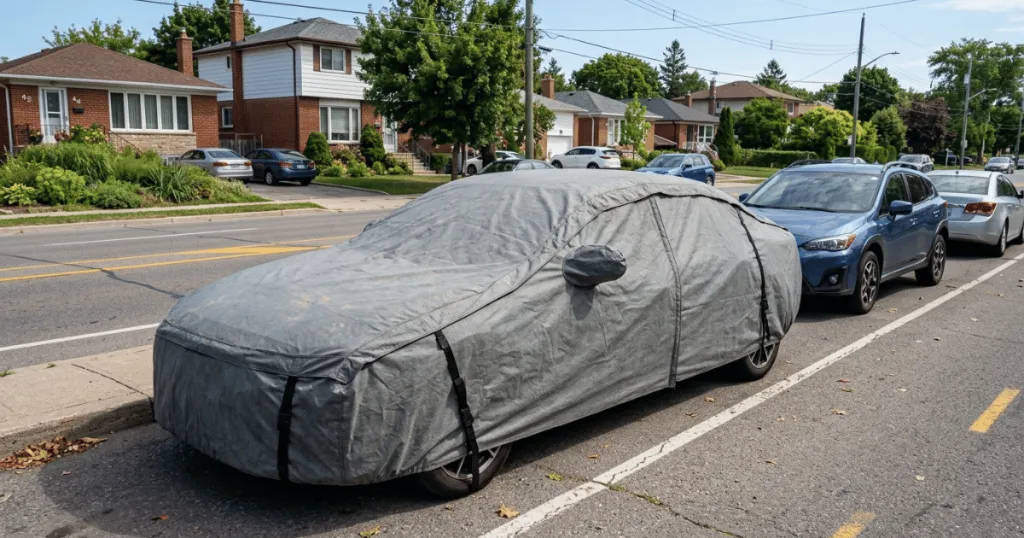
Core Challenges Faced During Urban Curbside Storage
Parked vehicles along public thoroughfares experience environmental factors that accelerate cosmetic and material degradation. The primary concern involves physical contact risks, ranging from accidental brushes by pedestrians carrying bags to light bumper bumps from nearby parallel parkers. A specialized street parking car cover acts as a physical buffer against minor abrasions, though it cannot stop a high-speed collision.
Weather exposure presents another major hurdle in dense city centers where tall buildings create wind tunnels and unpredictable moisture pockets. Rainwater mixed with urban smog forms acidic droplets that settle onto horizontal body panels, etching clear coats if left to bake under the sun. Furthermore, airborne industrial fallout, tree sap from municipal plantings, and aggressive bird droppings accumulate rapidly on open-air vehicles, demanding a textile barrier that resists chemical breakdown while shielding the paint.
Beyond immediate physical contact, public roadways expose vehicles to relentless solar radiation and fluctuating temperatures. Without an outdoor car cover, prolonged sun exposure bakes organic contaminants directly into the finish. This combination of heat and chemical residue accelerates clear coat degradation, resulting in a chalky appearance that requires professional paint correction to reverse.
Key Factors in Choosing a Street Parking Car Cover
Finding the right balance of durability and usability dictates whether a protective cover actually gets used daily or left folded in the trunk. Curb space is often tight, meaning the installation and removal process must be straightforward enough to manage in a narrow gap between traffic and the sidewalk.
Material Layering and Weather Defense
Multi-layered synthetic fabrics represent the gold standard for outdoor urban exposure. These textiles typically combine a water-resistant outer shell with a breathable middle layer and a soft fleece lining against the paint. Breathability is critical because trapped condensation from morning dew can cause moisture blistering under intense afternoon heat. A reliable street parking car cover manages this vapor exchange while keeping heavy rain and abrasive dust particles from penetrating the interior.
When searching for a dependable curbside car cover, buyers must look closely at how the material handles precipitation and humidity. A true weatherproof car cover utilizes microporous membranes that block liquid water from the outside while allowing internal moisture vapor to escape. This dual-action breathability prevents the formation of sweat pockets under the fabric, protecting delicate automotive clear coats from chemical etching.
Security and Locking Mechanisms
Leaving a valuable protective shell unattended on a public street introduces the risk of theft or unauthorized removal. Manufacturers address this by incorporating reinforced grommets and cable lock kits that thread beneath the chassis. Selecting a design with a secure strap-and-buckle system prevents sudden gusts of wind from lifting the fabric off the vehicle while parked in exposed urban corridors.
In busy neighborhoods, anchoring the material securely prevents opportunistic theft. A steel cable lock kit threads through built-in hem grommets to anchor the shell tightly to the vehicle frame. This deters casual tampering and ensures the protective layer remains in place despite heavy pedestrian traffic and municipal street-sweeping operations.
Fit Accuracy and Wind Resistance
Loose-fitting universal covers flap violently in wind tunnels created by passing traffic, which can dull clear coat finishes through constant friction. Custom or semi-custom cuts tailored to specific vehicle dimensions hug the contours of the body tightly. This snug geometry eliminates loose fabric pockets, reducing wind drag and keeping the protective layer firmly anchored to the car.
Achieving proper wind resistance relies heavily on selecting a custom fit car cover rather than a generic universal size. When fabric billows in urban wind corridors, the constant rubbing creates microscopic swirl marks across painted surfaces. A tailored cut hugs every body line securely, maintaining steady contact without abrasive flapping.
Real-World Scenarios and Daily Urban Management
Consider the daily routine of a commuter who relies entirely on residential street parking for an apartment complex. Every morning involves removing the protective shell, folding it quickly, and stowing it in the trunk before driving to work. Upon returning in the evening, the engine needs sufficient time to cool down before the cover goes back on, preventing hot exhaust pipes from melting synthetic inner fabrics.
Another common scenario involves long-term street storage during extended travel periods. When a vehicle sits untouched for weeks in an open public slot, environmental accumulation accelerates. Bird droppings left baking on the fabric for an extended period can eventually seep through if the material lacks sufficient chemical resistance. Regular inspection and prompt spot cleaning of the exterior cover maintain its protective capabilities over time.
Navigating municipal regulations also plays a role in daily management. Some jurisdictions require license plates to remain visible or prohibit long-term vehicle storage on public asphalt without movement. Choosing a design that accommodates local compliance rules prevents unnecessary fines or enforcement actions while keeping the vehicle shielded.
Why Proper Urban Vehicle Protection Matters
The financial and aesthetic cost of neglecting an exposed exterior becomes evident after just a few seasons of harsh urban weathering. Clear coat oxidation, permanent water spotting, and paint thinning decrease vehicle resale value significantly. Investing time and care into a quality street parking car cover preserves the underlying paint, reducing the frequency of aggressive detailing or costly repainting projects later on.
Beyond cosmetic preservation, maintaining a clean exterior protects rubber window seals, wiper blades, and exterior trim from premature cracking caused by persistent UV exposure. Urban grime acts as a magnifying lens for solar rays, intensifying heat absorption on dark paint colors. A reflective outdoor cover mitigates this thermal stress, keeping cabin temperatures slightly lower and protecting interior dashboard materials from sun-induced warping.
Furthermore, maintaining the exterior barrier shields the vehicle from constant airborne pollutants. Industrial fallout, brake dust settling from adjacent traffic lanes, and road salts combine to create an acidic film over unprotected panels. By utilizing consistent ultraviolet and dust defense measures, owners prevent these caustic agents from bonding permanently with the finish.
Common Misconceptions About Outdoor Car Protection
A frequent misunderstanding involves the assumption that any heavy tarp or waterproof sheet provides adequate defense against city elements. Heavy plastic tarps lack breathability, trapping moisture against the clear coat and creating ideal conditions for paint damage. True automotive covers use engineered microporous textiles designed specifically to repel liquid water while releasing trapped humidity.
Another myth suggests that keeping a car covered on a busy street draws unwanted attention or vandalism. In practice, a tightly fitted, neutral-toned cover blends into the background far better than a dust-covered, bird-stained vehicle body. Furthermore, physical coverage discourages casual tampering by hiding the vehicle contents and discouraging minor contact from passersby.
Some drivers also believe that washing the car weekly renders a cover unnecessary. While washing removes surface grit, it leaves the paint completely bare the moment the vehicle returns to curbside parking. Protection requires a continuous physical shield between wash cycles to intercept falling debris and solar radiation.
Final Decision Guidance for City Vehicle Owners
Choosing to deploy a street parking car cover requires weighing the daily effort of installation against the severe toll of unmitigated urban exposure. For car owners without garage access, selecting a multi-layer, custom-fit cover with security integration provides the necessary safeguard against environmental hazards. Prioritize breathability, wind stability, and secure anchoring systems to ensure the investment holds up against the demands of curbside storage.
Evaluate your specific parking conditions, including local weather patterns, tree density, and traffic volume, before settling on a material weight. By balancing ease of removal with robust weather defense, you establish a sustainable routine that protects your vehicle investment for years to come.
FAQ
Will a street parking car cover scratch the paint during windy days?
A poorly fitted, loose cover can cause micro-marring due to constant friction from wind gusts. Using a snug custom-fit street parking car cover with a soft inner fleece lining eliminates this risk by keeping the fabric stable against the body panels.
How do I secure my cover against theft on a public street?
Most quality outdoor covers feature reinforced built-in grommets paired with a steel cable and lock kit. This cable runs underneath the chassis of the vehicle, preventing anyone from easily removing or stealing the cover while parked on a public roadway.
Can I put a cover on a warm car after driving?
It is best to let the exhaust and engine bay cool down for a short period before installing your street parking car cover. Direct contact with extremely hot exhaust components can melt synthetic fabrics and damage the outer shell.